Stop Guessing Stocks!
Start Screening Like a Disciplined Investor.
Build Your Value & Hypergrowth Stock Screening System Using Clear, Repeatable Checklists


Most retail investors don’t lose because they lack stock ideas.
They lose because they have no filtering system. This gives them a repeatable checklist before they risk money.
Built for value-focused investors
Helps filter financially strong companies
Focuses on undervaluation, quality, and stability
Uses a checklist-based screening process
Helps avoid weak balance sheets and value traps
Designed for long-term, disciplined research
Ideal for investors who prefer patience over hype
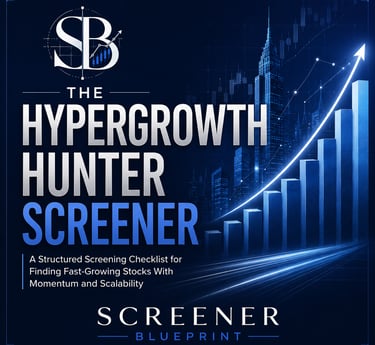
Built for growth-focused investors
Helps identify fast-growing companies
Focuses on momentum, scalability, and expansion
Uses clear screening criteria before deeper research
Helps filter noise from real growth potential
Designed for faster, sharper stock discovery
Ideal for investors looking for high-upside opportunities
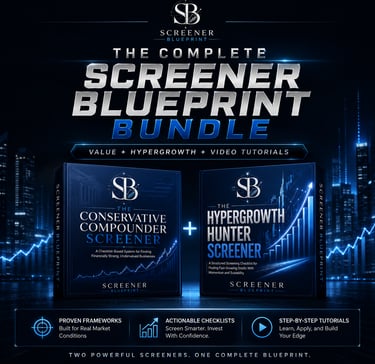
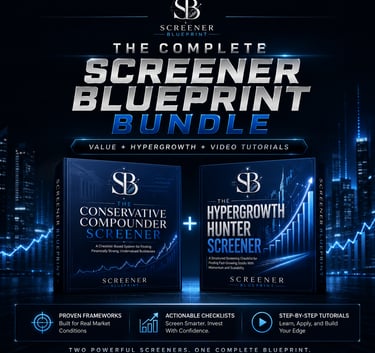
Includes both value and hypergrowth systems
Combines conservative screening with growth discovery
Includes video tutorials and practical walkthroughs
Helps build a complete stock-screening workflow
Designed to compare different types of opportunities
Saves time by giving you two structured research paths
Best value option for serious retail investors
Best for: conservative investors looking for quality businesses at reasonable valuations.
Best for: investors searching for growth stocks with strong momentum and scalable business potential.
Best for: investors who want the full system: value discipline, growth opportunity, and guided implementation.
Which Screener Is Right for You?
Choose Conservative Compounder if:
You prefer value investing, stronger balance sheets, lower hype, and long-term discipline.
Choose Hypergrowth Hunter if:
You want to screen for fast-growing companies, momentum, scalability, and expansion signals.
Choose the Bundle if:
You want both approaches and a complete screening workflow with video guidance.
What You Get Inside Screener Blueprint
Downloadable screening checklists
Clear filter logic for each strategy
Step-by-step video tutorials
Practical research workflow
Value and growth screening frameworks
Educational guidance for retail investors
No stock tips, no hype, no guaranteed returns
What Each Guide Gives You
The Conservative Compounder Screener
A step-by-step checklist for finding financially solid companies: balance sheet strength, valuation, margins, debt levels and red flags to check before you spend hours reading annual reports.
The Hypergrowth Hunter Screener
A separate framework for high-growth companies: revenue growth, momentum, scalability and basic risk filters, so you can build a cleaner watchlist instead of chasing hype. It does not tell you what to buy.
The Complete Screener Blueprint Bundle
Both frameworks together, for investors who want to evaluate value and growth companies with different criteria instead of mixing everything into one list, plus video walkthroughs that show how to apply each screen.
FAQ
Is this financial advice?
No. Screener Blueprint is for educational purposes only. It does not provide investment advice, stock recommendations, or guaranteed results.
Do I need investing experience?
Basic market knowledge helps, but the checklists are designed to make the screening process clearer and more structured.
Does this tell me which stocks to buy?
No. It helps you filter and research stock ideas. Final investment decisions are always your responsibility.
Is FINVIZ required?
The system is designed around stock-screening logic and can be applied using popular screener tools. It is not affiliated with FINVIZ.
What is included in the bundle?
Both screeners, video tutorials, and the complete workflow.
Educational use only. Not financial advice. No stock recommendations. No guaranteed results. Investing involves risk, including loss of principal.
Screener Blueprint is for educational and informational purposes only. Nothing on this website, inside any product, video, checklist, email, or downloadable material should be considered financial, investment, legal, tax, or accounting advice.
Screener Blueprint does not provide personalized investment recommendations, stock picks, trading signals, portfolio management, or instructions to buy, sell, or hold any security. Investing involves risk, including the possible loss of principal. Past performance does not guarantee future results.
You are solely responsible for your own research, decisions, and financial outcomes. Always consult a qualified financial professional before making investment decisions.
Contact
infoebookusa@aol.com
© 2026. All rights reserved.